Hydrocele
Hydrocele is a swelling caused by the accumulation of fluid around the testicle, usually painless and harmless.
It is commonly referred to as a “water hernia.”
Hydrocele is frequently seen in children and is often congenital. It is usually noticed in the first months of life and may resolve spontaneously in some cases.
Causes
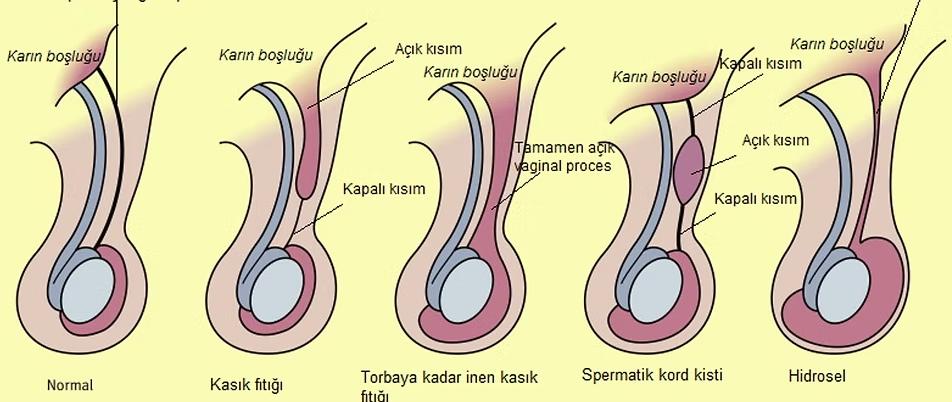
During fetal development, the testicles descend from the abdomen into the scrotum.
During this descent, a thin channel (the processus vaginalis) exists between the testicle and the abdominal lining.
After birth, this channel should close, but in some infants, it does not fully close.
Fluid from the abdomen can then pass into the scrotum, forming a hydrocele.
There are two types of hydrocele:
-
Communicating hydrocele: Fluid continues to move between the abdomen and the testicle; the swelling may increase or decrease during the day.
-
Non-communicating hydrocele: The channel is closed, and fluid is trapped around the testicle; the swelling remains constant.
Symptoms
Hydrocele is usually painless and does not cause discomfort to the child.
Parents often notice:
-
Swelling in the scrotum
-
Swelling that changes in size during the day
-
May be on one or both sides
-
Soft, fluid-filled appearance
-
Absence of pain, redness, or fever
If hydrocele is accompanied by an inguinal hernia, the swelling may become firm, painful, or extend toward the groin. In such cases, urgent evaluation is needed.
Diagnosis
Hydrocele is usually diagnosed with a physical examination.
-
Transillumination test: Shining a light through the scrotum; light passing through suggests a fluid-filled hydrocele.
-
Ultrasonography (USG): Used when the diagnosis is uncertain, to assess fluid volume, testicular condition, and possible hernia.

Treatment
Treatment depends on the type of hydrocele and the child’s age.
-
Observation (Spontaneous Resolution)
-
In newborns and infants, hydroceles often resolve on their own within the first year.
-
Regular check-ups are recommended until 1 year of age.
-
Gradual reduction of swelling is generally a good sign.
-
Surgical Treatment (Hydrocelectomy)
-
Surgery is indicated if the hydrocele persists after 1 year, grows larger, or is accompanied by an inguinal hernia.
-
The procedure involves a small incision in the groin, draining the fluid and closing the open channel.
-
Surgery usually takes 30–45 minutes, and same-day discharge is possible.
-
Recovery is quick, and no permanent scar remains.
If Left Untreated
Although usually harmless, untreated hydrocele may:
-
Gradually increase in size and cause cosmetic concern
-
Communicating hydrocele may develop into an inguinal hernia later
-
Rarely, fluid accumulation may press on testicular tissue, causing discomfort
Follow-Up and Recommendations
-
Any swelling in infants should be evaluated by a pediatric urologist.
-
Urgent consultation is needed if the swelling suddenly becomes firm, painful, red, or if the child is restless.
-
Post-surgical follow-up is important to monitor healing and prevent infection.
Our Clinic’s Approach
At our clinic, hydrocele diagnosis and treatment are planned according to the child’s age and the type of hydrocele.
Using modern surgical techniques, we aim for safe and aesthetically satisfactory outcomes.
Our goal is to protect the child’s health, comfort, and future testicular function.